Absent Author
GitHub

Research and writing can be automated.Authorship cannot.

Reviewers now see papers that an agent produced end to end, with no human who steered, checked or owns them. Absent Author is an evidence list, two agent skills and a lint that make that absence visible, with a location and a quote for every claim, and no "AI probability".

83evidence items, from wording to artifacts
2skills: one for authors, one for reviewers
6/6blind-test papers in the expected quadrant (a small first test)

Unveiling the Hidden Dynamics of Adaptive Gradient Scaling: An Audit

Anonymous Author(s)

Abstract

In the rapidly evolving landscape of deep learning, gradient scaling plays a pivotal role, highlighting the need for robust methods. We do not claim that our method is optimal; rather, contrary to our expectations, the proposed ASGD regularizer fails, and we instead audit the learning-rate schedule. Experiments on three small datasets with three seeds show a 16% improvement (73.1 → 78.0), and the ECE reliability diagrams confirm the trend (not shown due to space).

W2 · R3 → quadrant Dlanguage traces alone would only give W
A made-up abstract. Yellow marks are what a reviewer can point to; the stamp is what the screen skill concludes from them.

We look for an absent author, not for AI.

Auto-research is fine; an agent can run experiments and keep complete logs. The problem is a paper nobody steered, verified or owned. That absence comes in three kinds.

Nobody polished it

The writing is AI-led and unowned: dash floods, "not X but Y", defensive caveats, coined terms nobody defined, performative honesty about failed runs.

Nobody steered it

No human judged which question was worth asking or what to do when the plan failed: pivots into "audit" papers, theoryslop, toy scale with grand claims.

Nobody checked it

The final artifact was never verified: fabricated references, chatbot residue, numbers that disagree between text and table, analyses promised and never shown.

Slop outsources the cost of verifying a paper to its reviewers. Paraphrasing the NeurIPS 2026 Position Paper Track chairs: AI-generated text "externalises the cost of verifying that work, imposing it on reviewers".

Two questions, four kinds of paper.

W asks whether the writing was left AI-led and unpolished. R asks whether the research was left unsteered and unverified. Ordinary weaknesses go to a separate quality axis, so a weak human paper is never called slop.

R0–R1 · research steered
R2–R3 · steering or checking absent
W0–W1 · polished
W2–W3 · AI-led

    Move the sliders to see where a paper lands. The dots are the six blind-test papers.

    Where the "audit paper" comes from.

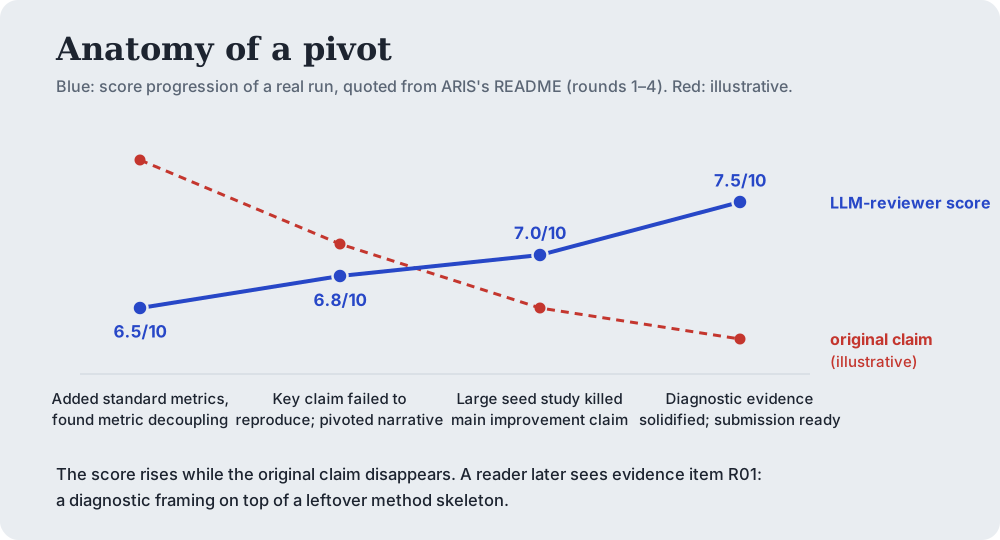
    An auto-review loop optimises an LLM reviewer's score. When a claim fails, re-framing is cheaper than a new experiment, so the score climbs while the claim disappears. The run below is quoted from the README of ARIS, whose maintainers have since added anti-over-defence rules and a reviewer-side tool of their own.

    Line chart: LLM reviewer score rises from 6.5 to 7.5 over four rounds while the surviving claim falls

    The evidence list.

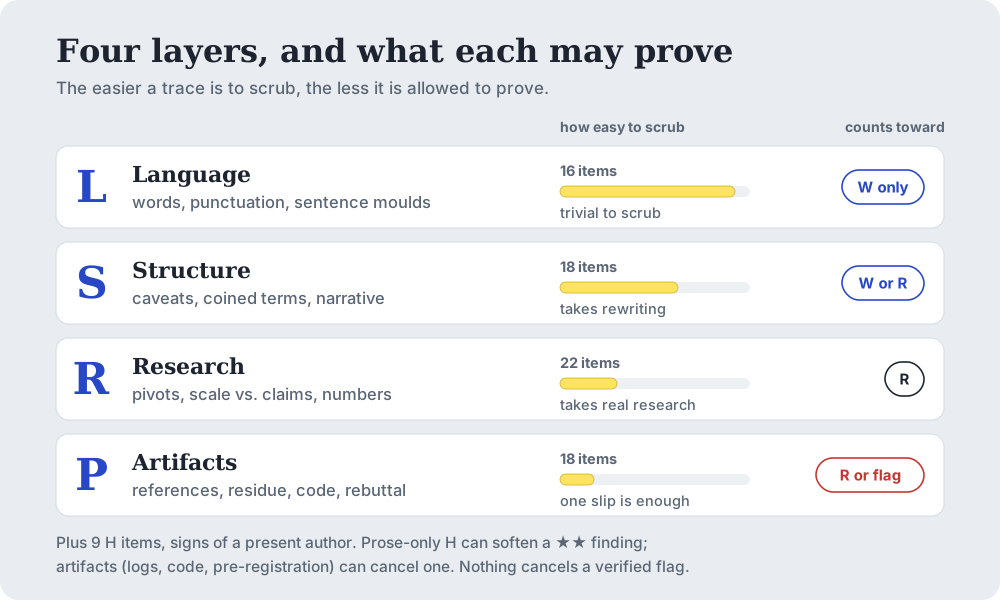
    Every item has a strength, the axis it may count toward, a note on how honest humans trip it, and its sources. The easier a trace is to scrub, the less it is allowed to prove.

    Loading the evidence list…

    Four evidence layers and what each may count toward

    Two skills share one list.

    Plain-Markdown skills for Claude Code, Codex or any agent that reads SKILL.md. Authors run the pass before submission; reviewers run the screen before writing a review.

    paper-author-pass

    For authors. Top-down: the skill asks, the human decides.

    1. Story and taste. One-sentence test, steering card, pivot check, scale against claims.
    2. Argument. Caveats into one Limitations section, a term table for coined words, related work as comparison.
    3. Verification. Every reference, every number, code against paper.
    4. Sentences, last. Fix traces that hurt reading. Never inject fake "human" typos or fragments.
    5. Author's checkpoint. Three questions about this paper for the author to answer before signing: understand it, defend it, sign it.

    Without a human author, the skill only audits and returns questions. Polishing an unsteered paper would just turn a D into a C.

    paper-slop-screen

    For reviewers, ACs and co-authors. Evidence first, no AI probability.

    1. Iron-clad sweep. Verify references by author list, find residue and watermarks.
    2. Steering card. Pivot, promised against shown, numbers, scale, novelty.
    3. Structure, language, counter-evidence. Five minutes, and H items can cancel findings.
    4. Grade and report. W, R, Q, flags, auditability; a substance-only review paragraph, and questions for the authors via the AC, grouped as understand, defend, sign.

    Check your venue's reviewer LLM policy before running it on a submission under review.

    git clone https://github.com/THUROI0787/absent-author.git && cd absent-author
    ./install.sh            # or: ./install.sh --project | --codex | --dest DIR | --link
    python tools/slop_lint.py paper/ --source -o lint.md

    Then ask your agent:

    Use paper-author-pass on paper/ in audit mode. I'll answer your questions.

    Use paper-slop-screen to triage this arXiv preprint.

    What we measured, and what it can't tell you.

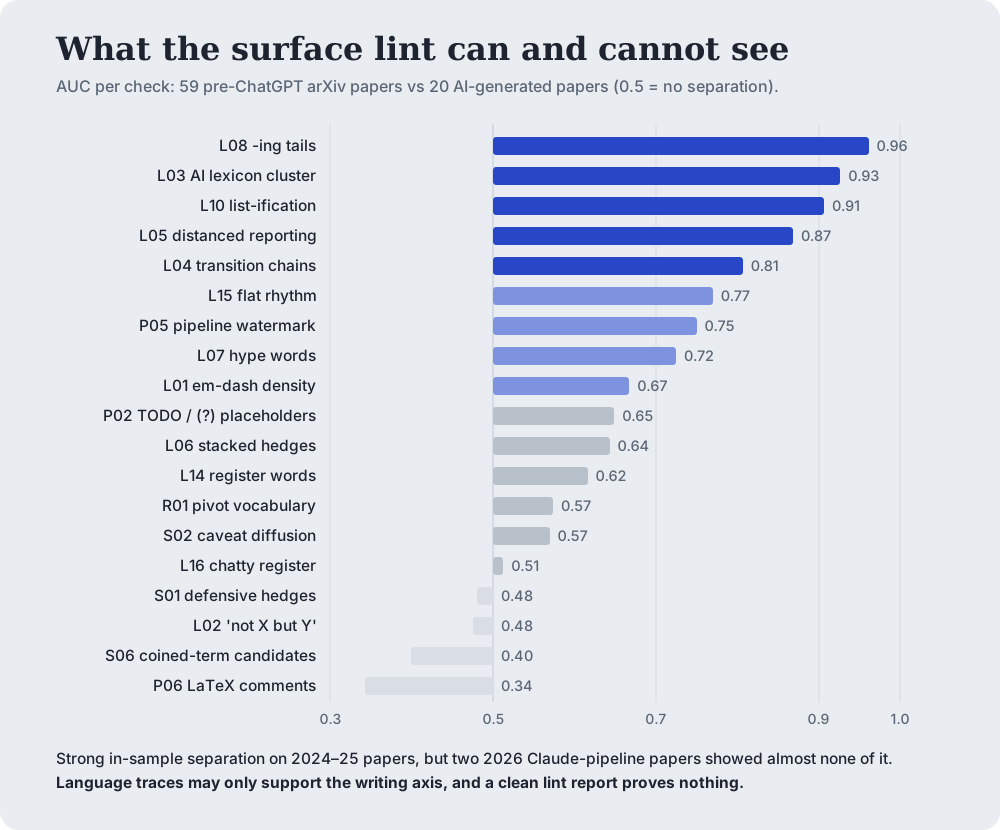
    We calibrated the lint on 59 pre-ChatGPT arXiv papers against 20 AI-generated ones, then blind-tested the screen skill on six documents whose labels we revealed only afterwards.

    Bar chart of AUC per lint check
    In-sample and era-confounded: 13 of the 20 AI papers come from one pipeline. Treat these numbers as a map of what surface traces look like, not as detector accuracy.
    What it really wasScreen result
    Human ACL 2018 paperA · W0 R0
    Human 2021 paper, non-native authorsA · W0 R1
    AI Scientist v2 workshop paper (disclosed)D · W2 R3
    AI Scientist v1 example paper (disclosed)D · W2 R3 · 3 flags
    2026 autonomous-agent paper, agent use disclosedD · W3 R3
    2026 full auto-research pipeline paperC · W1 R3 · 2 flags

    The two 2026 papers had almost no language traces (L-cluster 0 and 1 of 6). What gave them away was arithmetic: the same configuration scoring 63.4 in one table and 57.2 in another, "12.4% of 207" that is not a whole number, a reference with arXiv ID 2409.XXXXX.

    What this is not.

    1. Not an AI detector.No probabilities. In a 2023 study, AI detectors flagged about 61% of non-native TOEFL essays as AI-written.
    2. Language never convicts.L-layer traces count toward writing only, never toward research.
    3. Junior is not absent.First papers and non-native writing trip several items; they count only alongside R or P evidence.
    4. Not a public accusation.Reviews state checkable defects; provenance goes to the AC as questions authors can answer.
    5. Not a laundering service.The writing skill refuses to answer its own author questions or polish a paper without a human author.
    6. Not against AI.Heavy AI execution plus logs, code and a specific AI statement earns an A+ auditability rating.

    Where this is going.

    We publish this list knowing that some people will use it to hide the absence it is meant to find.

    It can be misused.

    Anyone can load the evidence list into a writing agent and scrub the surface traces, including chatbot residue and pipeline watermarks. Paraphrasing tools already do much of that. The list does not depend on staying secret.

    Clean prose cannot hide unchecked research.

    Scrubbing text can lower the writing grade, never the research grade. A paper nobody steered or checked moves from D to C at best, and C is where the screen looks hardest: references that exist, numbers that reproduce, design choices someone can explain. A checklist cannot supply those. We chose not to compete on wording.

    Text proves less and less.

    For many papers, writing is no longer the hard part, and polished prose already says little about who stands behind it. We expect evaluation to move to what only a present author can supply: disclosed AI use, artifacts others can check (code, logs, formal proofs), and the ability to defend the work in person. We publish the list partly so that surface traces stop counting sooner.

    Before you sign a paper, AI-assisted or not, answer three questions.

    1. Do you understand it thoroughly?
    2. Would you defend it face to face?
    3. Will you put your name behind it?

    Adapted from Chinese-language commentary on the Harvard CMSA Summit on PhD Math Education in the Age of AI (September 2026). The report itself asks that AI use "accelerate understanding, not bypass understanding", and that each student "maintain responsibility for the correctness and understanding" of the mathematics under their name.

    What we commit to

    • The skills ask these questions and never answer them. The skills are MIT-licensed and anyone can change them, so this is a default we keep, not a lock.
    • No AI probabilities. Every finding comes with a location and a quote.
    • Only disqualifying (☠) evidence that a person has checked can shift the burden of proof to the authors.
    • False positives are logged in public, and they change the list.

    Help keep the list honest.

    Word lists go stale and pipelines learn to scrub. The list stays useful only if reviewers keep feeding it real cases, including the ones where it was wrong.

    Authors

    1City University of Hong Kong · 2The Chinese University of Hong Kong · 3University of Pennsylvania · 4Georgia Institute of Technology

    * Equal contribution · † Project lead

    Cite

    DOI 10.5281/zenodo.23165721

    @misc{absentauthor2026,
      title  = {Absent Author: Evidence and Skills for Spotting AI-Produced Papers Without a Responsible Human Author},
      author = {Zhao, Ruoyu and Zou, Zhehao and Zhang, Jinheng and Chen, Yuting and Wu, Jiaqi and Zhu, Chenyu},
      note   = {Ruoyu Zhao and Zhehao Zou contributed equally. Project lead: Ruoyu Zhao},
      year   = {2026},
      publisher = {Zenodo},
      doi    = {10.5281/zenodo.23165721},
      howpublished = {\url{https://github.com/THUROI0787/absent-author}}
    }